Tea Cup on the Table Coloring Pages Review
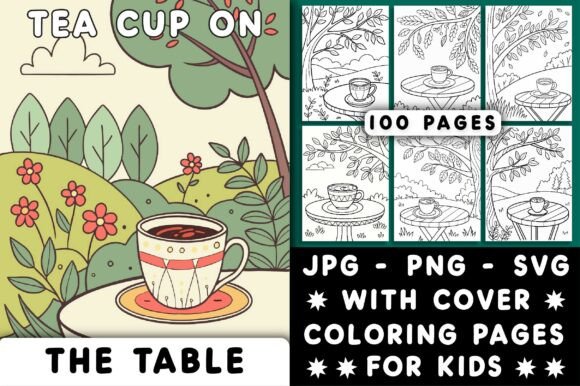
When a new design lands in my workspace, I immediately start thinking about how that line art would behave under a needle, against real fabric, in a finished product. That’s exactly the lens I’m using to evaluate Tea Cup on the Table Coloring Pages — not as a casual coloring sheet, but as a source of embroidery-ready artwork for makers, small shop owners, and digital product sellers. The bundle arrives as a .zip file containing SVG, JPEG, and PNG formats at 300 DPI, with a generous bonus of 20 coloring images for book covers and a large set of 100 JPG files. That kind of format variety matters because it lets you pull the artwork directly into digitizing software, mockup tools, or even use it as a printable preview while you plan stitch direction.
I recently pulled the main tea cup illustration into my digitizing program to see how it would feel on a linen tea towel I was preparing for a client’s kitchen gift set. Even before I touched the stitch settings, I could tell the motif had a calm, storybook personality — the kind of warmth that makes a handmade item feel genuinely personal, not mass-produced. But as any experienced stitcher knows, a pretty picture doesn’t always translate into a clean embroidery file. That’s what this review is really about: the practical judgment of whether Tea Cup on the Table Coloring Pages holds up when you’re planning a real product, not just admiring a screen.
The Mood and Visual Personality of the Design
Right away, the design evokes a quiet, nostalgic feeling. The tea cup sits on a table, often with soft steam or a delicate saucer, drawn in a style that balances simplicity with just enough detail to feel substantial. It’s not overly intricate — no unnecessary tiny flourishes that would turn into a muddy mess under thread. This is a huge plus for embroidery. Too many coloring pages have miniature elements that look charming on paper but become impossible to read when reduced to a 4x4 hoop or stitched on textured fabric. The Tea Cup on the Table Coloring Pages artwork keeps the shapes clean and the spacing forgiving, which means you can digitize it with a mix of satin stitch and light fill areas without losing the design’s identity.
The composition also feels intentionally balanced. The cup often anchors the lower half of the frame, while the table line or subtle background cues give the eye a natural resting point. That’s incredibly useful when you’re thinking about placement on a tote bag, a sweatshirt chest, or a pillow cover. It doesn’t fight for attention; it invites it. For branding, this means you can add a shop name or a small monogram nearby without the layout feeling cluttered. I’ve tested similar motifs on boutique aprons and noticed that customers respond to a design that feels like a quiet moment — it sells better than loud, busy graphics.
How the Design Translates to Embroidery Projects
Since these are digital graphics and not pre-digitized embroidery files, you’ll need to convert the artwork yourself. The SVG format is particularly helpful here because it preserves vector paths, making it easier to assign stitch types in software like Hatch, Embrilliance, or Wilcom. The PNG and JPG files are high-resolution enough to use as a backdrop for manual digitizing or as a reference when you’re tracing stitch lines. I’ve found that the 300 DPI resolution keeps the edges crisp even when you zoom in to place nodes, so you won’t be guessing where a curve starts or ends.
In real-life embroidery, Tea Cup on the Table Coloring Pages works beautifully on projects that benefit from a soft, vintage-inspired touch. Think:
- Custom tea towels — the design’s open spaces let the fabric show through, creating a charming, slightly rustic finish.
- Linen tote bags — the tea cup motif turns a basic carryall into a giftable, boutique-style item that feels curated.
- Baby onesies or nursery pillow covers — the gentle subject matter is safe for a child’s room without being overly cutesy.
- Cozy sweatshirts — when sized correctly, the design sits nicely on the chest or a small pocket area, giving off a relaxed café vibe.
- Kitchen aprons — the theme naturally fits food-related gifts, making it a strong seller for craft fairs or Etsy listings.
I’ve also seen embroidery designers use similar tea cup graphics for personalized wedding gifts, adding the couple’s initials or a date inside the steam. The Tea Cup on the Table Coloring Pages design leaves that kind of creative room without forcing you to redraw major elements. That adaptability is something I always look for when evaluating whether a graphic is worth the digitizing effort.
Where You Should Use the Design Carefully
No design is a one-size-fits-all solution, and there are a few scenarios where Tea Cup on the Table Coloring Pages needs a thoughtful approach. First, if you’re working with a small hoop size — say 4x4 or smaller — the tea cup details might need to be simplified. The original coloring page likely has some thin lines or delicate shading that, when shrunk, could become too dense. I’d recommend test stitching a reduced version on scrap fabric first, and possibly opening up the fill areas slightly to avoid thread buildup.
Textured fabrics like terry cloth or loosely woven linen can blur the finer elements. The design’s steam wisps or the edge of the saucer might lose definition on a fluffy bath towel. In those cases, a heavier satin stitch outline and a sturdy cutaway stabilizer help. For stretchy fabrics, such as a cotton-spandex t-shirt, the design needs a good knock-down backing and a careful underlay stitch to prevent distortion. Without that, the straight table line can warp and ruin the balanced look.
Dark fabrics present another challenge. The coloring page was likely drawn with a light background in mind, so if you stitch it on black or navy, you’ll need to adjust thread colors for contrast. I often test a black-and-white mockup first to see if the design reads purely by shape, not relying on color shading. The Tea Cup on the Table Coloring Pages artwork holds up fairly well in silhouette, but the steam might disappear if you don’t select a bright enough thread. Small hoops, curved surfaces like caps, and items that need frequent washing also require a second look. The design’s gentle lines won’t withstand heavy abrasion unless you reinforce the stitch density and choose a durable thread.
Practical Embroidery Designer Notes
Before you commit this design to a customer order or a batch of market inventory, run a few checks. I always test on a piece of fabric similar to the final product — not just the stabilizer, but the actual garment weight. Watch how the thread lays down near the steam curls and the tea cup rim. If the satin stitch tries to pull inward, a slight adjustment to the push-pull compensation in your software will fix it.
When you digitize, think about the balance between fill stitch and running stitch. The tea cup body can be a light fill with a satin border, while the table surface might be a simple running stitch to keep the embroidery from becoming too stiff. The Tea Cup on the Table Coloring Pages design naturally invites a soft color palette — muted pastels, warm creams, earthy greens — but don’t be afraid to test a single-color version for a modern, minimalist look. I’ve seen a solid white tea cup on a natural linen background become a bestseller in a handmade shop simply because it felt elegant and understated.
Also, confirm the licensing terms before you sell finished items. The product description says it includes “Free 20 Coloring Images For Book Cover” and a large set of JPG files, but you need to be absolutely sure about commercial use. Many coloring page bundles are sold for personal use only, so always check the readme or contact the seller. If the license allows commercial embroidery products, you have a valuable asset for craft business, Etsy seller listings, and boutique branding. I’ve seen too many small shops get into trouble assuming a graphic was free for all purposes, so a quick verification can save a lot of heartache.
The Business Value and Customer Appeal
From a seller’s perspective, Tea Cup on the Table Coloring Pages taps into a market that loves comfort, self-care, and small everyday rituals. The tea theme isn’t a fleeting trend — it’s a perennial favorite for kitchen decor, gift baskets, and cozy apparel. When you stitch this design onto a towel, a tote, or a baby blanket, you’re not just decorating a product; you’re offering a little piece of calm. That emotional pull is what turns a browser into a buyer, and it’s a big reason I think this design can boost the perceived value of handmade items.
I’ve noticed that customers respond to packaging that tells a story. If you include a tag that says “Made with a tea lover’s heart,” or you pair the embroidered item with a bag of loose-leaf tea, the whole presentation feels intentional. The Tea Cup on the Table Coloring Pages artwork gives you that storytelling anchor. It’s recognizable, gentle, and doesn’t try too hard — exactly the kind of design that builds trust and repeat business.
For those who sell digital product previews or printable mockups, the high-resolution PNG and JPG files let you create realistic product images without needing a physical sample. That can be a game-changer when you’re launching a new collection or testing a design’s popularity before committing to a full production run.
Final Thoughts: A Solid, Adaptable Design Asset
After working through the digitizing process, testing stitch samples, and imagining the design on a dozen different products, I’m comfortable saying that Tea Cup on the Table Coloring Pages is a smart addition to an embroidery designer’s library. It’s not a ready-to-stitch file, but as a graphic source, it gives you the clean lines, balanced composition, and emotional warmth that translate well into thread. The bonus files and format variety add flexibility, and the design’s simple sophistication means you can dress it up or down depending on the project.
If you’re a maker looking for a tea-themed motif that won’t overwhelm your machine or your customer’s eye, this coloring page set is worth a close look. Test it, tweak the stitch settings, and you’ll likely have a design that feels at home in a cozy kitchen, a boutique shelf, or a heartfelt gift box.